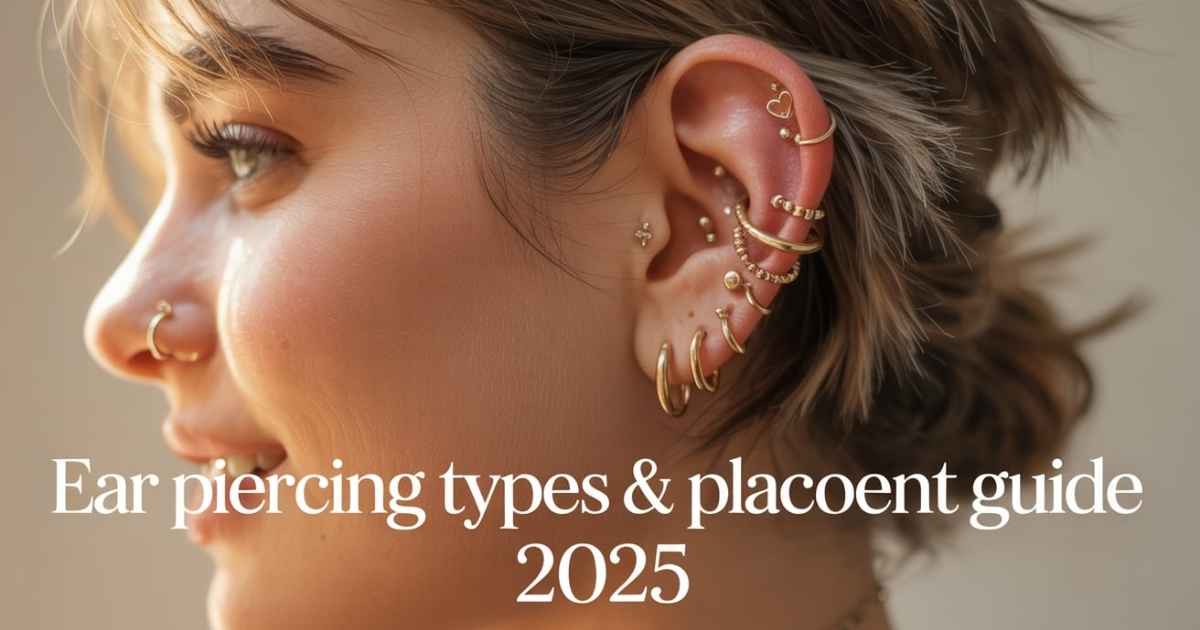
Imagine scrolling Instagram and spotting someone whose ear stack stops you mid-scroll. That perfect mix of tiny gold studs, delicate hoops, and bold bars? It’s not luck it’s strategy. Welcome to your ultimate ear piercing types and placement guide the only roadmap you need to build a jaw-dropping curated ear that’s totally you.
In the USA right now, over 83% of people have at least one piercing, and ear piercings dominate the trend charts. Ready to join the club (or level up your current setup)? Let’s dive in.
Overview of Ear Piercing Types and Placements
What Is Ear Piercing?
Ear piercing is the practice of creating a small hole in the ear to wear jewelry. It’s one of the oldest forms of body modification ancient Egyptian mummies even rocked gold earrings! Today, it’s all about self-expression and style.
Ear Anatomy Relevant to Piercings
Think of your ear as prime real estate. You’ve got the soft, fleshy lobe (the easiest spot), the firm cartilage rim (hello, helix), and hidden folds like the daith and rook. Knowing the map prevents painful mistakes.
Here’s a quick labeled cheat sheet (save this!):
Ear piercing placement chart showing lobe, helix, daith, tragus, conch, rook
Alt text: Complete ear piercing placement chart – all types of ear piercings labeled
Lobe Piercings: Styles and Placement Guide
Lobe piercings remain the most popular ear piercing styles because they heal fast and hurt the least.
Standard Lobe Piercing
Your classic, traditional lobe piercing the one you probably got at Claire’s as a kid. Most people now rock double lobe piercing or even triple.
Pain: 2/10 Healing: 6–8 weeks
Upper Lobe Piercing
Also called the second hole piercing or stacked lobe ear piercing. Sits higher on the lobe, perfect for creating that “floating” constellation look with tiny studs.
Transverse Lobe Piercing
This horizontal lobe piercing flips the script. A barbell runs side-to-side through the lobe instead of front-to-back. Rare, bold, and surprisingly comfy.
Cartilage Piercings: Types and Placement Insights
Ready to graduate from basic? Cartilage piercings take your ear game to expert level.
Helix Piercing
The king of upper ear piercings. Your ear rim piercing along the outer curve. Single, double, or triple helix stacks are everywhere on TikTok right now.
Forward Helix Piercing
Those three tiny studs near your face? That’s a triple forward helix. Hurts more than a regular helix but looks insane with flat-back labret studs.
Daith Piercing
The heart-shaped inner ear cartilage piercing that sits deep in the fold above your ear canal. Fun fact: many migraine sufferers swear a daith hoop reduces attacks (science is still debating, but the style is undeniable).
Tragus and Anti-Tragus Piercings
- Tragus – that little flap covering your ear canal. Great for small studs or dainty hoops.
- Anti-tragus – the ridge opposite the tragus. Often paired together for symmetry.
Pro tip for AirPods lovers: tragus jewelry rarely interferes once healed.
Specialized and Complex Ear Piercing Placements
These are the “I’m committed” options.
Industrial Piercing
Two helix holes connected by one long barbell. Still the ultimate statement piece in 2025.
Rook and Snug Piercings
- Rook – the thick inner fold above the daith. Notoriously painful (8/10) but stunning with a curved barbell.
- Snug – the inner vertical fold. Looks amazing with tiny gem clusters.
Conch Piercing
Inner or outer conch piercing in the center bowl of your ear. Big hoops here scream confidence.
Orbital Piercing
Two separate holes connected by one ring that “orbits” the helix or conch. Often confused with industrial totally different vibe.
Jewelry Choices and Materials for Ear Piercings
| Jewelry Type | Best For | Top Picks in 2025 |
| Flat-back labret studs | Fresh cartilage & forward helix | Threadless titanium or 14k gold |
| Seamless hoops | Healed helix, daith, conch | 14k gold or implant-grade steel |
| Curved barbells | Rook, snug, industrial | Titanium (least irritation) |
| Captive bead rings | Conch, daith, orbital | Solid gold for luxury feel |
Material must-knows:
- Implant-grade titanium – #1 for sensitive ears
- 14k or 18k solid gold – never gold-plated (it flakes!)
- Skip cheap “surgical steel” from fashion stores many contain nickel.
Healing, Pain Level, and Aftercare for Ear Piercings
Typical Healing Times by Piercing Type
| Piercing | Healing Time | Pain Level |
| Standard lobe piercing | 6–8 weeks | 2/10 |
| Upper lobe piercing | 6–10 weeks | 3/10 |
| Helix piercing | 6–12 months | 6/10 |
| Forward helix piercing | 8–12 months | 7/10 |
| Daith piercing | 9–12 months | 7–8/10 |
| Industrial piercing | 9–18 months | 8/10 |
Pain Level Expectations
Real quote from reader Mia in Seattle:
“My forward helix felt like a quick bee sting. My rook? I squeezed my best friend’s hand so hard I left bruises!”
Effective Piercing Aftercare (The Rules That Actually Work)
- Leave it alone (LITHA method).
- Clean twice daily with saline no alcohol or hydrogen peroxide.
- Sleep on the opposite side.
- No headphones over fresh cartilage for 6 months.
Saline Solution and Safe Hygiene Practices
DIY recipe: ¼ teaspoon non-iodized sea salt + 1 cup distilled water. Store in a clean spray bottle. Spray, let air-dry. Done.
Frequently Asked Questions
What is the difference between a helix and an industrial piercing?
Helix: single hole on rim. Industrial: two holes connected by bar.
Can you explain the procedure for a daith piercing?
Piercer clamps inner fold, needle curves through cartilage, inserts hoop.
What are the pain levels associated with tragus and conch piercings?
Tragus: 5-6/10 sharp pinch. Conch: 6-8/10 deeper thump.
How long do helix piercings take to heal?
Full healing takes 6–12 months, downsize jewelry at 3-4 months.
What type of jewelry is recommended for a new industrial piercing?
Long straight titanium barbell with room for swelling.
Are there specific aftercare instructions for ear piercings?
Saline spray twice daily, no touching, sleep on opposite side.
Conclusion
There you have it your complete ear piercing types and placement guide. From the safe standard lobe piercing to the fearless industrial, the options are endless. Pick what makes your heart race, trust a reputable piercer (APP members only!), and rock your new look with confidence. Which ear piercing types are you adding next? Drop a comment below let’s talk style!